
In winter in Korea, mandarins are the best snack. Nothing beats the superior taste of mandarins eaten one by one when you are snuggled into your comforter in the cold winter. There is another mandarin variety that enhances the sweet and sour taste-it is Korean late harvest mandarins. Late harvest mandarins are called so because they are harvested later than general mandarins, and they come in various types from Hallabong to Cheonhyehyang and Redhyang. Although similar in shape to oranges, the late harvest mandarins are distinctly different from oranges and have a higher sugar content and acidity than oranges, showing the quintessence of sweet and sour mandarin taste. Late harvest mandarins raising awareness worldwide for their quality, with export to the United States. What kind of late harvest mandarins does Korea have?
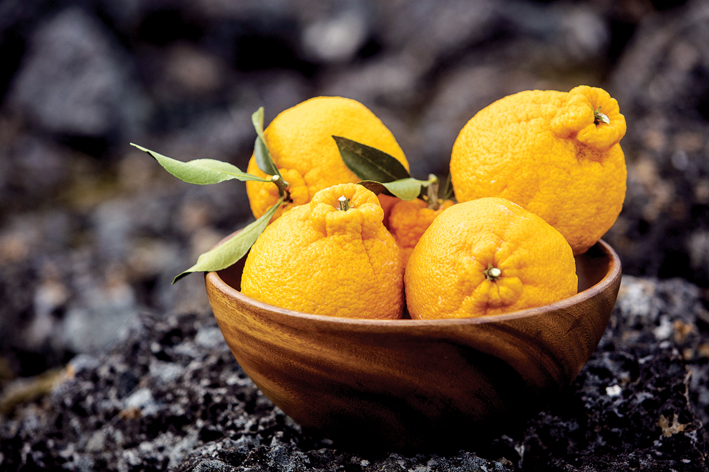 Hallabong
#Leader of Late Harvest Mandarins, Hallabong
A representative of late harvest mandarin is Hallabong, which is gourd-shaped with a pointed tip and looks like a mountain peak. Hallabong is named so because it resembles the peak of Hallasan Mountain in Jeju-do (Island), and it is the longest-loved variety of late harvest mandarins. Cultivated on Jeju-do since the 1990s, Hallabong has thick skin but, it peels off easily if the stem is carefully nipped. The flesh is soft, juicy, and has a high sugar content. ‘Jeju Hallabong’ was also registered as Korea’s Agricultural Product Geographical Indication No. 100, indicating that Jeju Hallabong has been recognized for its geographical characteristics and excellence in quality.
Jeju-do also produces processed foods using Hallabong, such as Hallabong tea or Hallabong jam. According to the Jeju Business Agency of Jeju-do, Shibuya Marui Department Store in Tokyo, Japan, etc., have been selling Jeju Natural Foods’ stick-type Hallabong tea, an agricultural company, since 2021. In addition, Hallabong tea and Hallabong jam are scheduled to be introduced in a US online shopping mall soon, targeting companies that participated in the US export fair held by the Jeju Bio Business Association last April.
Exports are also being prepared for Tamra Foods’ Hallabong tea and Cosat’s Hallabong tea using mandarin peel. With the growing interest in, it is expected that export can be expanded to China, Hong Kong, and Vietnam.
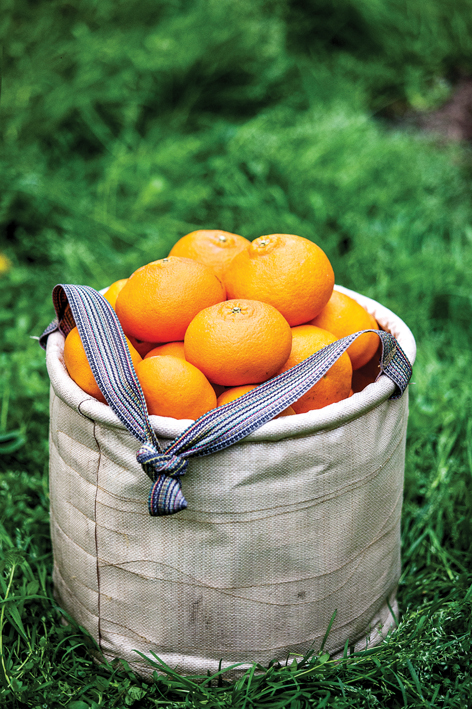 Cheonhyehyang
#There isn’t just Hallabong, Cheonhyehyang and Redhyang
There are late harvest mandarins comparable to Hallabong’s popularity-Cheonhyehyang. Cheonhyehyang has the meaning of ‘scent travels a many miles’ or ‘scent from heaven’. It has a low acidity and a very high sugar content. Redhyang is the youngest of the top 3 of late harvest mandarins. Redhyang has skin that turns red when ripe and a thick and plump kernel, so it has an excellent texture. Cheonhyehyang and Redhyang both look like mandarins and have thin skin, but Cheonhyehyang has a smooth surface while Redhyang has a bumpy surface. Redhyang has a lower acidity than Cheonhyehyang, so it tastes much sweeter.
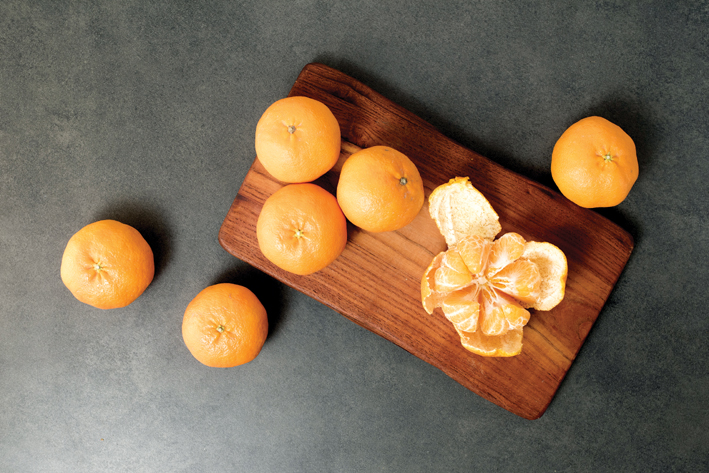 Redhyang
There is also Hwanggeumhyang. Meaning ‘the fragrance of wealth and luxury’, Hwanggeumhyang is similar in shape to an orange and the size of Hallabong. It has little to no sour taste and is rich in sweetness. In terms of cultivation time, Hwanggeumhyang is harvested the earliest among late harvest mandarins in early December, Hallabong and Redhyang are harvested from December to March of the following year, and Cheonhyehyang is harvested from January to April. Winterprince, developed in korea in 2016, has a higher sugar content than that of Hwanggeumhyang, which is shipped at the same time, and has moderate acidity. Winterprince is easy to eat because it has no seeds and is easy to peel.
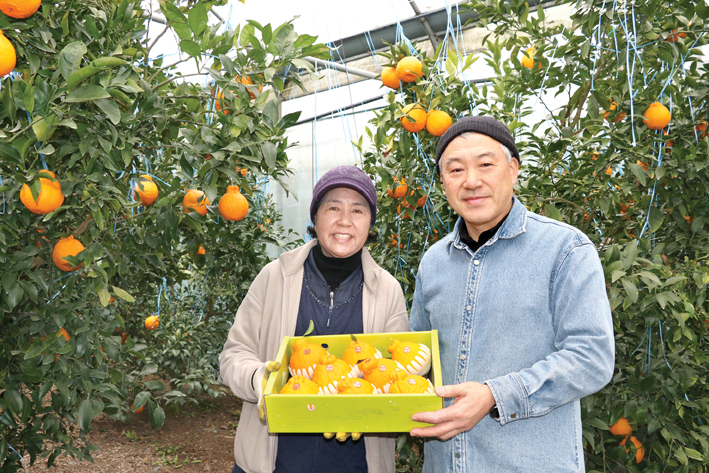 Hallabong farm 'Lee Ga Won'
#Jeju Hallabong Heads to the World
Hallabong has a unique shape and excellent taste, so it is highly marketable. It had confidence that it could be recognized as a premium gift like Shine Musket in overseas markets. This led Jejusi National Agricultural Cooperative Federation (JNACF) to start exporting Hallabong from 2019, and at the center of this was Lee Ga Won, a Hallabong farm. In 2020, 7 out of 8 tons of Hallabong exported by JNACF, and all 10 tons of Hallabong exported this year were produced by Lee Ga Won. Lee Ga Won Hallabong boasts the highest quality.
Lee Ga Won only harvests the original Hallabong, with the peak rising high. In addition, Each branch is tied with a string so that all Hallabong can receive direct sunlight. Only then will the size and taste be consistent. Its other feature is the application of GCM (Gelatin Chitin Microorganism), an eco-friendly farming method using microorganisms that can decompose gelatin and chitin. This farming method helps crops to grow healthy with metabolites produced during the microorganism cultivation process.
Kim Yong-suk, CEO of Lee Ga Won, said, “The quality of late harvest mandarins increases as they are cared more. As we have been growing mandarins for three generations, we are confident in our ability to let people around the world taste true Jeju Hallabong.” Lee Ga Won exports Hallabong to Malaysia, Hong Kong, and Singapore.
JNACF’s export performance of late harvest mandarins including Hallabong increased from 21 tons in 2020 to 40 tons in 2021. These achievements were also thanks to its great brand power. JNACF’s export-only brand is ‘Jesmerize’, a compound word of ‘Jeju’ and ‘Mesmerize’ with an aim to captivate the hearts of people around the world with Jeju’s agricultural products. The logo also has a Hallasan Mountain shape. It is analyzed that when overseas consumers saw and heard the brand, they immediately thought of Jeju and Jeju agricultural products which resulted in a huge promotion effect as a result.
JNACF plans to expand the annual export volume of late harvest mandarins to 100 tons in the next five years and is considering the creation of a late harvest mandarin export complex that can uniformly produce high-quality products, like Lee Ga Won. Koh Bong-ju, President of JNACF, said, “We will do our best to ensure that Jeju’s late harvest mandarins become the best agricultural products that captivate the taste buds of people all across the world.”

Email : Blizzard@nonghyup.com
Tel : +82-64-750-6112
Fax : +82-64-723-8002